


Why Are We Craving Sourness Again?
LOST IN TRANSLATION: LIFE OF A JAPANESE GIRL IN ITALY
The world of bacteria is, in some ways, remarkably simple. Microorganisms, much like us, ‘eat’: they consume sugar and convert it into the energy they need to move and survive. We, in turn, consume the by-products of that metabolism. Since moving to Italy, I’ve become far more aware of this microbial world than ever before.
Lactic acid bacteria feed on the lactose found in milk and produce lactic acid. Their speciality is coagulation: using the acid they create to tighten and solidify the proteins in milk. One day, a classmate from Ecuador told me you could easily make yoghurt using supermarket milk and a small amount of yoghurt as a starter. She even mixed cow’s milk, goat’s milk and Greek yoghurt to create flavours she preferred.
It sounded simple enough, so I tried it myself — and failed spectacularly. The problem was that I had overheated the milk. She had said the ideal temperature was ‘just warm enough that you barely notice it when you dip a finger into the pot’, roughly body temperature. Instead, I heated it to the point where the bacteria could no longer function. As a result, the lactic acid bacteria barely worked, and the milk never became acidic enough. What I ended up with was a strange, sticky, runny liquid, somewhere between milk and yoghurt, with barely any sourness at all. That was the moment I realised yoghurt bacteria live at almost exactly the same temperature we do.

Yet the failure taught me something too. When I told a friend about it, she said, “Don’t throw it away — you can use it as buttermilk instead!” Fermented milks like these are known as ‘cultured milk’. The versions sold commercially are not accidental creations like mine; producers carefully control temperature, salinity, acidity and time in order to decide which microorganisms will thrive.
I used the milk in banana pancakes and fried chicken. The batter and meat became astonishingly tender. When strained, it turned into something like labneh; reheating the leftover whey produced floating proteins that looked almost exactly like ricotta. Everything was connected.

Later, during a visit to a Parmigiano Reggiano dairy, I learned that cheesemaking, too, depends on a kind of ‘baton pass’ between lactic acid bacteria. The previous day’s milk is left to rest overnight so the fat can separate, then combined the next morning with fresh milk. The whey produced the day before is reused as the starter culture for the next batch. Cheese, in this sense, is an act of carrying microorganisms across days. The same principle applies to sourdough, which has seen a resurgence in home baking over the past few years. Made from nothing more than flour, water and salt, naturally leavened bread contains two microorganisms living side by side: wild yeast and lactic acid bacteria. The wild yeast feeds on sugar and produces gas, causing the dough to rise. The lactic acid bacteria, meanwhile, create the distinctive sourness and aroma. For a long time, bread production chased uniformity. In Japan especially, convenience stores and supermarkets are filled with sweet breads and soft packaged loaves made with sugar, butter and industrial yeast, alongside additives designed to guarantee the same flavour, softness and quality every single time. Yet now, people are turning back to sourdough once again.
After decades of uniformity, why are we craving ‘sourness’ again today?
For a long time, sourness signalled food on the verge of spoilage. It was a warning that something might no longer be safe to eat, so humans instinctively learned to avoid it. Now, though, that meaning has shifted. Sourness has become associated with ‘natural’ food, gut health and artisan production. As interest in fermentation and the microbiome continues to grow, what was once seen as a sign of danger is increasingly desired as proof that something is alive.
Since arriving in Bra, I’ve met plenty of people with years of sourdough experience behind them. They bring sourdough loaves flavoured with walnuts, grapes, lemon, coffee, herbs or garlic to picnics; they make focaccia and pancakes from discarded starter. They also tell beginners that supermarket Manitoba flour is the most reliable option — though, since much of it comes from Canada, many travel to local mills instead to buy organic wheat, mixing wholemeal and rye flour in whatever proportions they like.


I tried making it myself, though I still can’t bake it consistently well.
The kitchen in my flat has huge windows, so the temperature rises quickly. The dough can easily overproof and lose its structure. Even when I follow recipes from more experienced bakers or from books, I still have to adjust things depending on the environment — sometimes even the weather that day. That’s what makes it difficult, and fascinating. Sourdough is less about labour than it is about waiting: waiting for fermentation, waiting for the dough to rise, waiting for it to settle.
And of course, the bread hardens quickly with time. But lately I’ve started wondering whether bread that stays permanently soft on supermarket shelves might actually be the unnatural thing. Perhaps that is why countries with strong bread cultures, Italy included, still hold on to so many ways of making stale bread delicious again.
Still, there is one thing I can say with certainty: homemade sourdough is delicious no matter what. You can slice it fresh from the oven and eat it with melting butter, or let it cool completely, toast it, and spread it with jam. Water, flour, starter, and salt — that’s all it is. Yet the flavour has extraordinary depth. Lately, I’ve found myself thinking that if something this simple can taste this good, perhaps bread is something we should bake for ourselves after all.
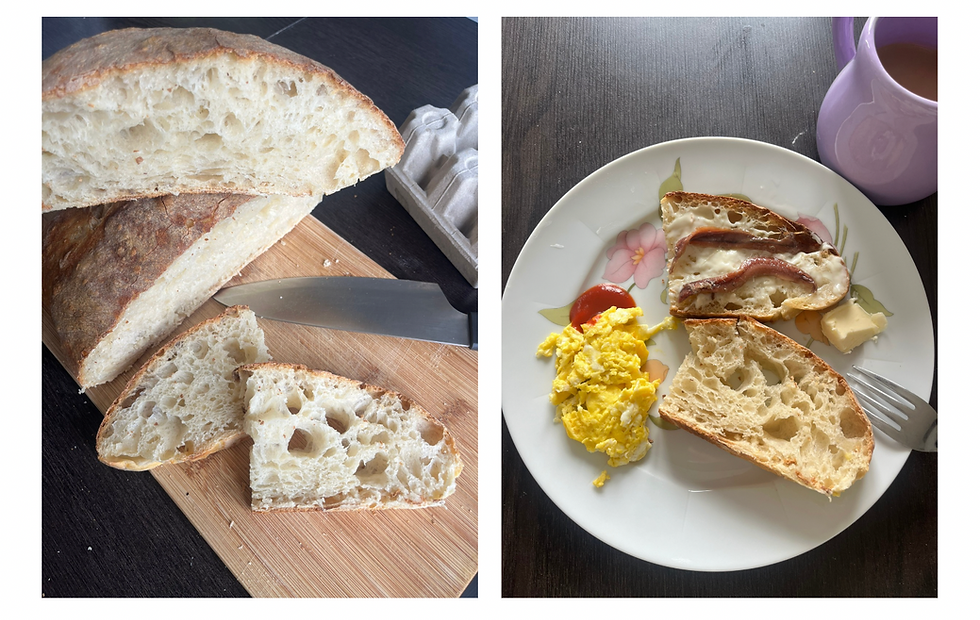
I think humans have always lived by ‘eating alongside microorganisms’. Yet because we can never fully control them, we have to adjust constantly and wait for them to reach the state we hope for. Working with lactic acid bacteria made me realise that fermentation is not about reproducing a perfectly uniform, lifeless flavour; it is about learning how to eat with something alive. I brought one of my homemade sourdough loaves to a bakery in Bra that had amazed me the first time I visited. The baker ran sourdough workshops at my university and shared starter with students. In Italy, natural starter culture has a long history; it is known as lievito madre — literally, ‘mother yeast’. The bread I had baked was made from that very starter. When he tasted it, the owner said, “Come back tomorrow at 5:30 in the morning, and I’ll show you how we make the bread.” In the next instalment, I’ll share what I discovered while apprenticing at an Italian bakery. Follow our journey @movimento.metropolitano.


