What Does Bread Mean to Italians?
- 3 days ago
- 6 min read
Italian Bakery Apprenticeship Series (3)
LOST IN TRANSLATION: LIFE OF A JAPANESE GIRL IN ITALY
I baked a sourdough loaf using the starter shared by a local bakery in Bra. The next day, I returned to the bakery to ask what they thought of the result. That conversation unexpectedly led to an invitation. I spent several mornings learning alongside the bakers. This is the final instalment of my series. I want to share my observations and the quiet philosophies behind how Italian bakers make bread. 1. What Italians Mean by ‘Pasta’
When people hear the word pasta, they usually think of the Italian dish served with sauce. Working in a bakery, however, I realised the word is used more broadly.
Pasta madre refers to a natural sourdough starter. Pasta sfoglia is laminated pastry, while pasta frolla is the shortcrust dough used for tarts and biscuits. Even pizza dough is called pasta per pizza. I gradually realised that, for Italians, pasta does not primarily mean a plate of spaghetti or tagliatelle. It simply means dough: flour mixed with water and transformed by human hands.
Thinking about it this way, I began to notice a difference in how dough is understood across cultures. In Japan, bread, pastries and noodles tend to be seen as separate categories. In Italy, they feel much more closely connected. What they have in common is pasta—dough.
It also made me realise how rarely we make dough by hand in Japan. Making udon is certainly part of our food culture, but it often feels like a special occasion rather than a daily activity.I was reminded of this when a Chinese friend's mother taught me how to make dumplings and baozi. Watching her work, every movement seemed effortless. She rolled, folded and shaped the dough without hesitation. It made me realise that, unlike in Japan, there is a closer everyday relationship with flour.
According to my friend, foods made from wheat flour are collectively called miànshí in Chinese. The word miàn does not just mean noodles; it also forms the basis for wheat flour (miànfěn) and dough (miàntuán), revealing a broader way of thinking about flour-based foods.
‘Perhaps, for us, noodles are the default way of thinking about foods made from wheat flour.’ Hearing this, I was reminded of the Italian word pasta.Both Italy and China have long histories of wheat. Perhaps that is why they see a broader concept before distinguishing between noodles, bread, or pastries: dough.
Learning these words made me realise that language reveals how people group foods. The word pasta, which I first encountered in a bakery in Bra, changed how I think about wheat culture.
2. The Fundamentals of Italian Bread
I was struck by the sheer range of ingredients Italian bakers use. They have far more choices than I imagined for starters, fats, and flour.
Different breads rely on different fermentation methods. At the bakery where I was learning, focaccia was made with brewer's yeast and malt. Watching the bakers, I realised bread and beer belong to the same cereal culture. The bakers called malt 'sugar'. In reality, malt does something rather different. It doesn’t add sweetness directly. Instead, it gradually converts wheat starch into sugars to feed the yeast steadily. It does not force fermentation; it gently encourages it by drawing out the grain's potential. Somehow, that approach felt distinctly Italian.
The same attention to detail extends to fats. Focaccia might contain olive oil, lard, or sunflower oil for different textures. Vegan bomboloni use sunflower oil, while cornetti often rely on margarine.
But, what fascinated me most was flour. Even a visit to an ordinary supermarket can feel overwhelming. In Japan, we tend to think in relatively simple categories such as bread flour and cake flour. In Italy, flour is classified in detail. Beyond soft and durum wheat, there are Tipo 00, 0, 1, 2, Integrale, Manitoba, and many more. Each has different milling grades and baking characteristics.

What surprised me more was that these flours were not used by rigid rules. For example, Farina Frolla is generally associated with biscuits and tart pastry. Yet the bakery where I trained also used it to make focaccia. At first, I wondered why. Then I tasted the result. The focaccia was astonishingly light, almost cloud-like, with an incredibly soft crumb.
The more I watched, the more I realised that Italian baking is defined by choice, not by fixed recipes. A baker first imagines the bread they want to create: its texture, aroma and character. Only then do they choose the flour, starter and fats that will bring that vision to life. It is this flexibility, and this deep understanding of ingredients, that I came to recognise as true craftsmanship.
3. Bread Rooted in Place
I noticed that local Italian bakeries are deeply rooted. The bakery's signature sourdough is called Pane di Bra, named after the town. In Japan, bread rarely identifies so closely with a specific place.
Even famous Italian classics are adapted to local tastes. Take cannoli. The Sicilian original uses a fried pastry shell filled with ricotta. Though in the Bra area, I found versions with baked puff pastry (pasta sfoglia), filled with zabaione cream and finished with chopped hazelnuts.
At first, I wondered why they changed such an iconic dessert. Then I realised authenticity here means something different. Rather than faithfully reproducing the flavours of Sicily, the goal is creating something delicious in this place. It uses local ingredients, traditions and tastes. Perhaps that is why Italian regional food remains so vibrant. Recipes travel, and they are allowed to change.

After all, Piemonte is known for hazelnuts and dairy. The bakery filled focaccia with local cheese and ham from Bra. Sweets were flavoured with Marsala or Vermouth. These have deep roots in this part of Italy. I began to feel that Italian bakeries are not places that sell standardised products found across the country. They are actually places that translate local ingredients into everyday food.
One day, the bakers offered advice: ‘Imported ham and cheese may be expensive in Japan, but couldn’t you make bread like this using local vegetables and Japanese ingredients instead?’ That idea felt new to me. The point is not reproducing an Italian bakery exactly like this in Japan. It is applying what I learned here—how to handle dough, how to work with fermentation, how to think through texture and flavour—and use these with Japanese ingredients. A bakery like this would be more than authentic. It would be natural, sustainable, and a richer place.
4. The Philosophy of Italian Bread
One characteristic I noticed across many Italian breads and pastries was a sense of restraint. The aim never seemed to be to make one ingredient dominate the others, but to allow each of them to express itself.
Lemon was used just enough to perfume the dough. Even when rum or Marsala was added, the alcohol never overwhelmed the other flavours. Cheese, too, was used generously without becoming heavy. Focaccia di Recco is perhaps the best example. Although it contains almost 800 grams of cheese, the finished bread is surprisingly light. Farinata, meanwhile, is little more than chickpea flour, water and olive oil, yet its appeal lies precisely in that simplicity.


Italian bread is rarely showy. Looking back, I realised that this says something about what Italians expect from bread. Health is not generally understood as a matter of restriction. Certainly, more people are choosing wholegrain loaves, ancient grains or seeded breads. The conversation rarely seems to revolve around low carbohydrates or fewer calories. Instead, people talk about bread being natural, digestible, or made with good ingredients. It’s less about removing something and more about bringing out the qualities that are already there.
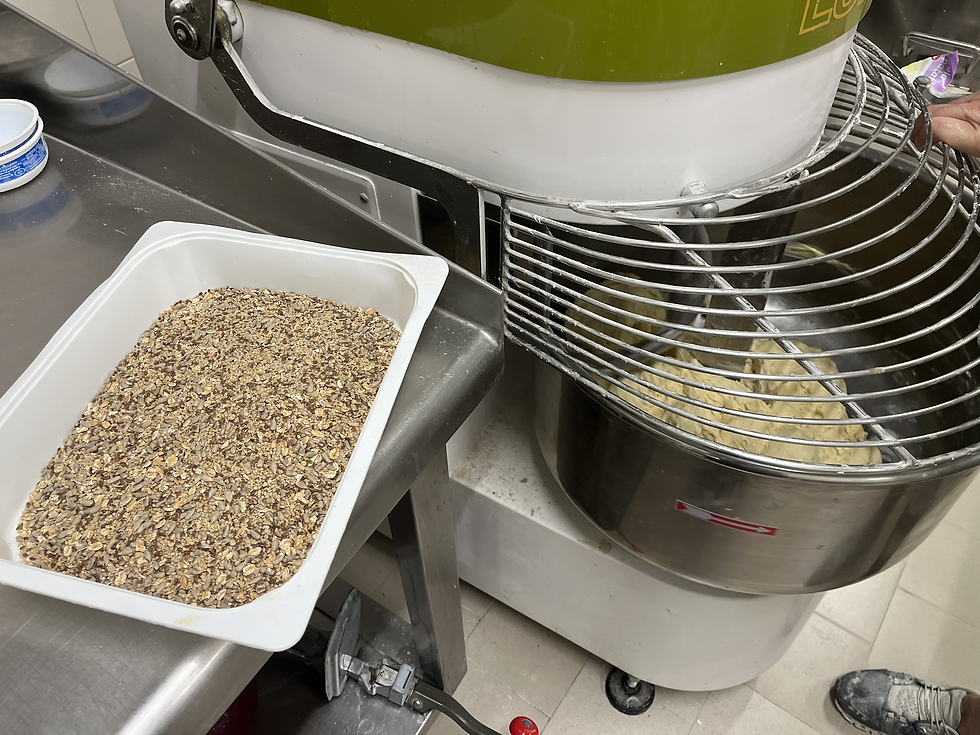
People in the bakery described bread as digestible. They’d say, ‘This one is easier to digest’ or they’d note, ‘The long fermentation is gentler on the stomach.’ This made me wonder. Perhaps it is not about abstract health trends like healthy eating, but about something much simpler: bread that people can enjoy every day, and that sits comfortably with the body.
Final reflections
Until now, I simply knew that I loved Italian bakeries.
Spending time in one, I now see them differently. Behind every loaf is an idea of what bread should be, and of what people expect from daily food. What looks effortless is, in fact, the result of many small decisions: the choice of flour, the type of starter, the amount of fat, the length of fermentation—every detail was observed, adjusted and refined, day after day. Good bread cannot be copied. It carries the baker’s years of knowledge, and the life of the place where it is made. This is what I came to admire most. Italian bread is rarely showy. It naturally fits into people's lives.
Afterword
I am deeply grateful to the owner. He generously opened his doors to a student eager to learn, and he shared so much of his craft with me.
As we said goodbye, he smiled: ‘Come back during panettone season.’
I imagine that making panettone with a traditional Northern Italian lievito madre is a different world: richer, slower, and even more demanding than the breads I learned this time. I hope to deepen my understanding of Italian bread before I return. One day, I look forward to knocking on the bakery door again.
Follow our journey @movimento.metropolitano.