


Case 1: Skin Inflammation, Skincare and Diet
Questions I Never Thought to Ask
Living in Italy, there have been many moments when everyday life or problems with my body have made me wonder, ‘Why don’t we learn this at school?’ or ‘Am I the only one who doesn’t know this?’ Or perhaps I just forgot some of what I learned in school.
By researching things for myself and trying them out, I have gradually begun to understand my own body and the way I live a little better. Understanding ourselves better also helps us care for others. In this series, I want to share what I have learnt along the way, from basic knowledge for everyday life to little things I have discovered while living in Italy.
In August, while doing an internship in another Italian city, I developed a skin irritation. It may have been triggered by a new sunscreen I had bought that contained fragrance. Continued sun exposure while traveling made it worse, leaving me desperate for a fix.
I started using vitamin C face masks morning and night, but my skin only got worse. Eventually, I dropped the extra products, stuck to gentle moisturisers, and shaded myself with a hat and parasol. What I needed was a skincare routine based on doing less, rather than adding more. As I reduced the number of products I was putting on my skin, I also began paying more attention to what I was eating every day. Diet alone won't cure inflammation, but proper nutrition and hydration help from within.
But there turned out to be quite a few constraints between deciding to ‘eat better’ and actually putting it into practice. I share a kitchen with three other people, and I only have one shelf in the fridge. The ingredients available here are also different from those in Japan. So I decided to start by understanding what my body needs, and then work out what I could realistically do within my current living situation.
Four Essentials for Supporting and Repairing the Body
① Carbohydrates: Are Bread, Honey and Mushrooms All Carbohydrates?
I think human history is largely a search for 'sugars'.
In Japan, rice became the centre of the diet, but depending on the region, people also obtained energy from foods that grew locally, such as taro and yams.
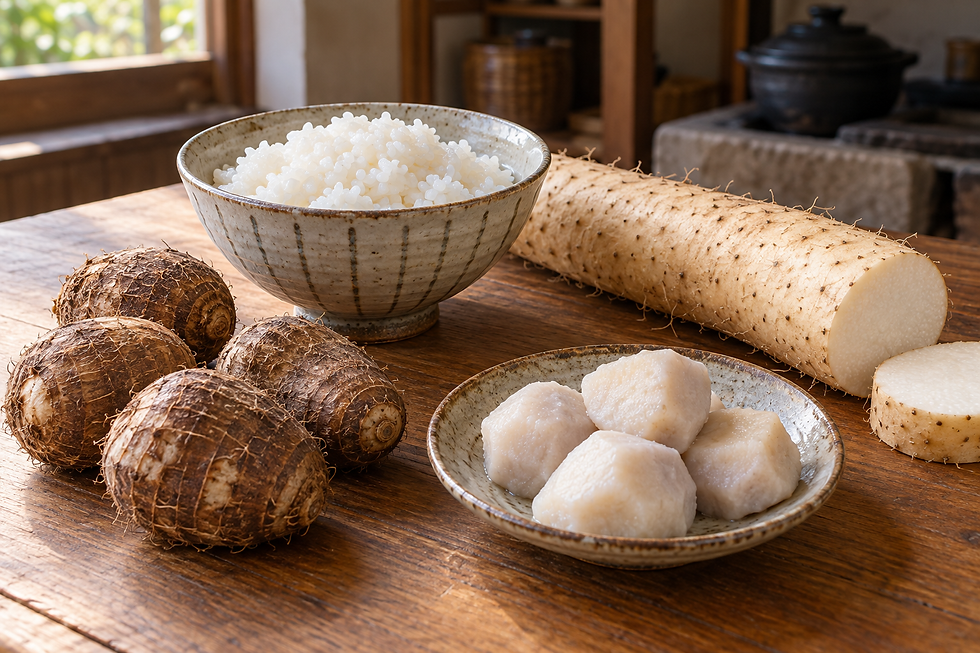
Carbohydrates include sugars, starch and dietary fibre.
Glucose, one type of sugar, is an important source of fuel for both the body and the brain. Carbohydrates are not simply something to avoid because ‘they make you gain weight’; they also support our everyday activities. Starch, found in large amounts in rice, bread and potatoes, is made up of many glucose molecules linked together. Some types of dietary fibre are also made from glucose, but because the glucose molecules are linked differently, human digestive enzymes cannot break them down. Even with the same building blocks, the body handles them differently. Meanwhile, what we usually call ‘sugar’ is made from one molecule of glucose joined to one molecule of fructose, a sugar also found in fruit. When we eat, starch is broken down into glucose, while sugar is broken down into glucose and fructose before being absorbed. The concentration of glucose in the blood is what we call ‘blood sugar’. After a meal, insulin is released and helps cells take up glucose. This means that blood sugar rises not only after eating sugar, but also after eating bread or rice. How much and how quickly it rises also depends on the amount we eat and what we eat it with. Even the white bread I love contains starch, and sweet bread has added sugar on top of that—a double hit. We had been getting sugars from foods that don’t even taste sweet.
What surprised me most when I looked into all this was that both honey and mushrooms can be said to ‘contain carbohydrates’. Honey contains a large amount of sugars. Mushrooms, on the other hand, contain a lot of water as well as dietary fibre. Though grouped under one word, their nutrient profiles and dietary roles are completely different. I understand the explanation now, but somehow it still feels strange to me that honey and mushrooms can be described using the same word.
② Protein: What Should I Eat in a Town Where Fish Is Hard to Buy?
Protein supports the structure of tissues in both the human body and the foods we eat.Proteins are made up of many amino acids linked together. Our bodies break protein down into amino acids to build muscle, skin, hair, and tissue.
In Bra, a landlocked town, it is not always easy to buy fresh, affordable fish as part of my everyday shopping. So the foods I tend to rely on are eggs, tinned tuna in water, white beans, yoghurt and milk. I would also like to include tofu when I can find it at an Asian supermarket or elsewhere.
Living in Italy, I have easy access to delicious cured meats such as prosciutto and salami. They are great protein sources, but their high salt and fat content mean I eat them in moderation.
The same goes for cheese: I want to think about both the type and the quantity. I might add ricotta or cottage cheese to a meal, or crumble a little salty feta over a salad or bean dish. With feta, it can double as seasoning, too.
For now, I can start simply by not letting a meal end with just bread or just pasta, but eating something like eggs or beans alongside them. That feels manageable even within the way I live now.
③ How to Eat Vegetables
After my skin became irritated, I felt that I needed to eat more vegetables, so I found myself eating salads almost every day. But after a while, I started desperately craving warm stews and tomato sauce. I also felt as though my stomach was getting cold, and sometimes I would fill up on salad and end up not eating my bread or eggs. But is it actually better to eat vegetables raw? Prolonged boiling destroys heat-sensitive, water-soluble vitamin C.
But I had read somewhere that ‘peppers are better cooked’, and had been stir-frying them ever since. Should I have been eating them raw instead? Apparently, it is not quite that simple. Peppers contain not only vitamin C, but also a group of pigments called carotenoids. You cannot decide how best to cook a vegetable by looking at just one nutrient. The beta-carotene in carrots and pumpkin and the lycopene in tomatoes are also carotenoids. Chopping, cooking, or pairing carotenoids with healthy fats improves nutrient absorption.
Beta-carotene is converted into vitamin A in the body, where it helps support the normal functioning of cells, including those in the skin. With tomatoes, I could marinate them in olive oil or turn them into a warm tomato sauce. Carrots don’t always have to go into a raw salad either; I could make ninjin shirishiri, an Okinawan-style dish of stir-fried carrots. I can add eggs or tuna, too, and when I am craving something warm, that sounds much more appealing. And I can get vitamin C from fruits that are easy to eat raw, such as kiwi, citrus fruits and strawberries.
In practice, fitting ideal nutrition into everyday life is not always simple. Washing and drying leafy vegetables can feel like a chore. Bags of pre-cut salad from the supermarket quickly start to discolour while sitting in the fridge. With limited fridge and freezer space, there isn't room to store lots of prepared meals.
Honestly, I cannot see myself buying a whole large pumpkin and cutting it up. But I can buy a single carrot, which also contains beta-carotene. I can also look for pumpkin that is already cut or frozen. If I keep a bag of frozen broccoli or spinach, I can take out only what I need. I can combine it with eggs in a frittata, or add it to pasta sauce or soup. I used to think of frozen vegetables as something you use only because you are too busy to cook properly. But for the way I live now, they can simply be a practical choice. Realising I don't need to eat vegetables raw made getting enough of them much easier.
④ Fats: Where Am I Getting Them From, and How Much?
One thing that surprised me while researching this was seeing glycerol appear again. When my skin was irritated, I had been paying attention to it as a moisturising ingredient in skincare. It turns out that the main components of cooking oils and butter are molecules made up of glycerol joined to three fatty acids. Glycerol itself is not an oil, but suddenly, a name I had been seeing in skincare was connected to the food I eat as well. Fats are used to build cell membranes and also help the body absorb fat-soluble vitamins. We need them, but gram for gram, fat provides roughly twice as much energy as carbohydrates or protein, so I also want to be mindful of how much I am eating.
Living in Italy, I use olive oil a lot when I cook. But whenever I bring a bottle home to my family in Japan as a souvenir, it gets surprisingly little use. At home, we used rapeseed oil for stir-frying and sesame oil when we wanted to add flavour. I realised that even the same kind of ingredient will not become part of a kitchen unless there are dishes in which people actually use it.
The fatty acids found in fats and oils can be divided into saturated and unsaturated fatty acids. Eating too much saturated fat can raise LDL cholesterol in the blood. Swap saturated fats like butter and fatty meat for olive oil, fish, and nuts.
Perhaps because of the image of the Mediterranean diet, I often hear that ‘olive oil is good for you’, but it isn’t calorie-free.
When I drizzle it straight from the bottle over salad or bread, I lose track of how much I have used. Two tablespoons contain around 220 kcal! So I have started pouring it onto a spoon first, just to see how much I am actually using. The same goes for tahini, which I love: what looks like a small amount can contain surprisingly a lot of energy. Some unsaturated fatty acids are also essential fatty acids, meaning that our bodies cannot make them and we need to obtain them from food. These include the omega-6 fatty acid linoleic acid and the omega-3 fatty acid alpha-linolenic acid (ALA). ALA is found in foods such as perilla oil, flaxseed oil and walnuts. I could use one of these oils to finish a salad, or simply add some walnuts to yoghurt. There are plenty of other ways to include fats, too: sprinkling sesame seeds over a salad or putting avocado on bread, for example. Recently, I have become rather fond of adding ingredients like these to my salads. DHA and EPA, found in oily fish, are also omega-3 fatty acids. The body can make them from ALA, but only in limited amounts, so there is also value in getting them directly from fish. Fresh, affordable fish can be difficult to find in Piedmont, but tinned mackerel or sardines from the supermarket would be easy enough to add to a salad or pasta.
According to data from Japan’s Ministry of Agriculture, Forestry and Fisheries, the annual per-capita supply of fats and oils roughly doubled between fiscal 1965 and 2025. Thinking back, oil and butter did not appear on my grandparents’ table nearly as often as they do in my own diet. I drizzle olive oil over salads and happily eat cheese and salami. Perhaps as Western-style foods have become more familiar in Japan, the number of occasions on which we consume fats and oils has increased as well. I used to think that fat was simply something I should cut down on. Now, I want to start by understanding where the fat in my own diet comes from, and how much of it I am actually eating.
Getting Everyday Life in Order: Three More Essentials
⑤ Dietary Fibre: Where Can I Get It From?
Looking around an Italian supermarket for foods that contain dietary fibre, there are plenty of options: oats, chickpeas and lentils, wholemeal bread and pasta, among others. Avocados contain fibre, too. I had never really thought of oats as a source of dietary fibre in particular. Having yoghurt with oats and nuts for breakfast could be another option besides buying sweetened granola.
Thinking back to what I used to eat in Japan, there are also potatoes and other root vegetables, mushrooms, and seaweeds such as wakame. Onions are easy to add to both stews and miso soup.
For fruit, there are kiwi, pears, plums and prunes. The effects of kiwi and prunes on bowel function have also been studied. In addition to dietary fibre, prunes contain sorbitol, which helps draw water into the bowel.
However, suddenly increasing the amount of fibre in your diet can apparently cause bloating. I want to introduce it little by little and learn what works well for my own stomach.
⑥ Fermented Foods: Do They Contain Live Microorganisms?
Fermented foods that I can easily find in Italian supermarkets include yoghurt and sourdough bread. Miso, soy sauce, kimchi and sauerkraut are fermented foods, too. In Japan, I ate miso daily without thinking; in Italy, I deliberately reach for yogurt to get fermented foods.
But not every fermented food contains live microorganisms when we eat it. Baking kills the live cultures in sourdough, while heat and processing determine if miso or pickled veggies retain theirs. Being made through fermentation and still containing live microorganisms when we eat it are two different things. Even pickles can be made in different ways: some are produced through lactic acid fermentation, while others are simply preserved in vinegar. They may both be ‘sour vegetables’, but the process behind them is different. The next time I pick up a jar at the supermarket, I want to look at the ingredients and how it was made.
Then there is the word ‘probiotics’, which I hear all the time. I learnt that it refers to live microorganisms that have been shown to provide a health benefit when consumed in adequate amounts. So even if a yoghurt says that it ‘contains lactic acid bacteria’, that alone does not mean it will ‘help with my constipation’. I would need to look at which particular microorganism it contains and what effects have actually been demonstrated.
⑦ Hydration and Electrolytes: Is Electricity Flowing Through Our Bodies?
When I came across the phrase ‘replenish your electrolytes’, I started wondering what an electrolyte actually was.
The fluids inside our bodies contain minerals such as sodium and potassium dissolved as electrically charged ions. When talking about the body, these are known as electrolytes. Our bodies use the movement of these ions to create electrical signals in the nerves and send instructions to our muscles to ‘move’. I realised that moving the body requires not only fuel, but also a system for transmitting instructions. Electrolytes are also involved in maintaining the body’s fluid balance.
I might think about drinking enough water, but I had paid much less attention to the fact that food itself contains water, and that we also obtain minerals through the foods we eat every day. In ordinary circumstances, I can drink enough fluids and eat proper meals. On hot days or when I have been sweating, I can pay more attention to hydration. And when I am sweating heavily for a long time, I can also think about replacing the salt and other electrolytes I am losing.
Even when I come across a complicated-sounding word like ‘electrolytes’, I don’t necessarily have to start by looking for a special drink. I can begin simply by looking at what I am already eating and drinking every day.
What Can I Do in My Own Kitchen?
I found myself thinking about Japanese dishes such as gomoku-ni, tonjiru, nabe and takikomi gohan. In Japan, we use the word gomoku for dishes that bring together small amounts of several different ingredients in a single dish.
That made me want to introduce one of the salads served at my university canteen, which I have taken to calling my ‘gomoku salad’. It brings all sorts of different ingredients together on one plate, and that alone makes the meal more enjoyable. And the fact that it costs only five euros makes me very happy.

I don’t have to have all of these ingredients at once. But the idea of simply adding one more thing to a dish feels like something I can take home with me. Inspired by the university canteen, I also tried making my own salad at home with ancient wheat and peaches.
I started looking into food because of my skin irritation, and realised that simply knowing more can give me more choices, even in the same supermarket and on the same budget. I began taking a closer look at sections I had always walked straight past and picking up ingredients I had never bought before. It was still the same supermarket, but somehow the world of ingredients had become a little wider.
At the same time, I could not simply incorporate everything I read online was ‘good for the body’ into my everyday life. What I can find at the supermarket nearby, what I feel like eating when I am tired after university, and how much energy I have left to cook all vary from day to day. Little by little, I want to find a way of eating that suits both my body and the life I am living now.
Follow our journey @movimento.metropolitano


