Attitudes Towards Raw Food
LOST IN TRANSLATION: LIFE OF A JAPANESE GIRL IN ITALY
Not long after I arrived in Bra, my landlady insisted, ‘You have to try Salsiccia di Bra — it’s the town’s speciality.’ So she took me to a local butcher’s shop.
The butcher behind the counter happily offered me a taste. Back in Japan, I had never been entirely comfortable with the distinctive texture of raw meat — that soft, slightly slippery feeling — so I put it into my mouth with a little hesitation.
I was genuinely astonished. It was delicious. Soft and silky, yet with just enough texture to remind you that it was meat. The mouthfeel brought to mind negitoro, the minced tuna often served with spring onions in Japan. There was a delicate sweetness to it, too. The subtle aroma of the spices lingered pleasantly in my nose. It was exactly the kind of flavour I love.

Italy has a long tradition of cured meats such as prosciutto and salami, most of which have historically been made from pork.
Bra, however, sits in the heart of the land of the Piedmontese — or Fassona — cattle breed, an area renowned for the quality of its beef. During the Middle Ages and the early modern period, the nearby town of Cherasco was home to a Jewish community, who for religious reasons, could not eat pork. It is said that local butchers in Bra responded by creating a distinctive sausage made primarily from veal instead. Because it is prepared with exceptionally high-quality veal, the tradition here has long been to enjoy it fresh and uncooked. Even today, that culture of appreciating raw meat remains part of the region's culinary identity.
Today, it’s typically made with veal as the main ingredient, enriched with a small amount of pork belly and seasoned with salt, black pepper, cinnamon, nutmeg and cloves. At one butcher's shop where I stopped to ask about it, the owner proudly told me, ‘Ours is 90% beef and 10% black pork.’ Every butcher has their own recipe and balance of spices. Comparing them is part of the pleasure. There are probably several reasons why this sausage continues to be eaten raw. Bra's cool climate has long made it easier to preserve fresh meat, while a small network of local butchers has carefully handed down traditional methods and rigorous standards of quality. Just as importantly, generations of local people have placed their trust in those artisans.
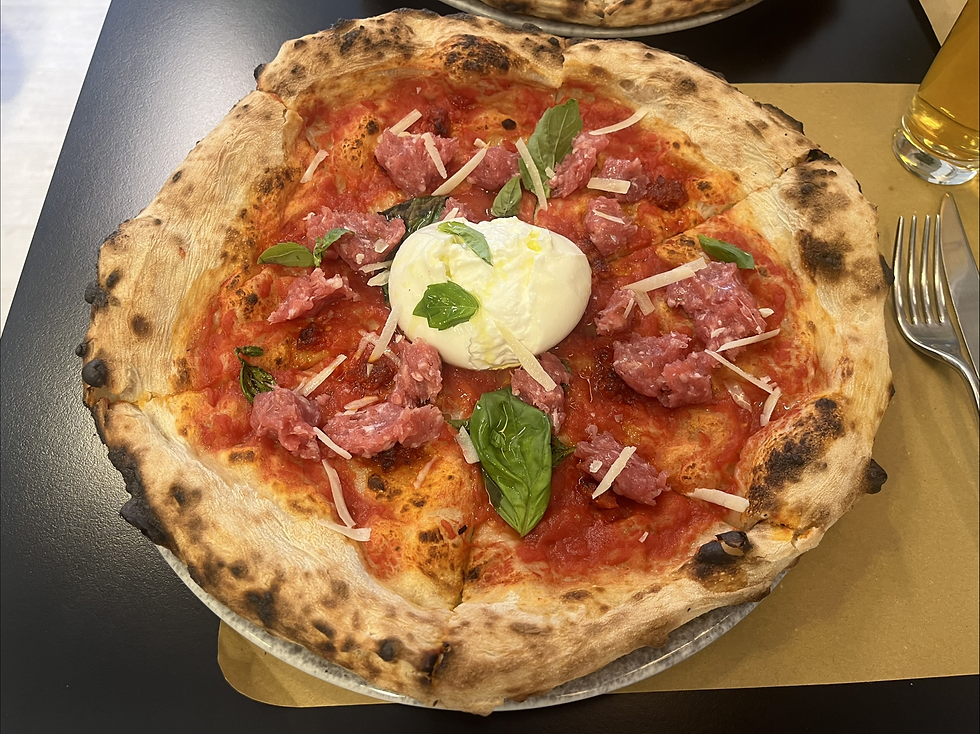
You can buy this sausage from a local butcher and eat it just as it is, perhaps with a drink. It appears on pizzas and panini, and more recently has even found its way into poke bowls. In restaurants, it’s often served as an antipasto. In this town, eating raw meat is woven into everyday life in a way that still surprises me. In fact, many of the international students around me say exactly the same thing: ‘Salsiccia di Bra is the best thing to eat in Bra.’


But eating raw meat was not the only thing that surprised me when I came to Italy.
In supermarkets, eggs are sold at room-temperature, and people keep them that way at home as well. I had always thought they were something that absolutely had to be refrigerated. Growing up, my mother and my cooking teachers taught me to use separate chopping boards for meat, fish and eggs, to cut fresh ingredients before handling raw animal products, and to wash my hands carefully every time I touched them. Whenever I cook with friends from all over the world here at the university, I often find myself thinking that perhaps the rest of the world simply doesn’t worry about these things quite as much as we do. Perhaps Japan’s humid climate has shaped a deep-rooted awareness that fresh food spoils quickly. Japan has its own traditions of eating raw meat, too — dishes such as yukke and basashi. Yet because food poisoning incidents are never far from the headlines, it often feels as though society naturally leans towards the safer option: perhaps it is simply better not to eat it at all. What surprised me even more was seeing my Italian friends taste a little of the raw meat while making polpette (meatballs). Of course, they would always tell me, ‘Don’t do it yourself — it’s dangerous.’ But I couldn’t help feeling that, in Italy, there is still a kind of embodied knowledge that says fresh, high-quality meat can be judged in its raw state. Perhaps that confidence is not in the ingredient itself. It is about trust — trust in the skill of the butcher who prepared it. This may seem like a slight digression, but one of my Indian friends washes chicken under running water before cooking it.
When I asked why, he told me, ‘Back home, if we wanted chicken, we would go to the farm and watch it being slaughtered in front of us. Washing it was just part of the process. I know I don’t need to do that in Italy, but it’s a habit’.
A chicken that has just been slaughtered still carries traces of feathers, blood, innards and smell. So you wash it. But perhaps that act is not simply about hygiene; it is something closer to a ritual, a way of transforming an animal into food. Growing up in Tokyo, I had only ever encountered neatly packaged meat, already presented as an ingredient. The idea of witnessing that transition from living creature to food felt entirely new to me, and revealed a profound difference in the way we relate to what we eat.
Then again, Japanese people think nothing of eating raw fish. Sushi and sashimi are part of everyday life, and I have never personally found them frightening. It made me wonder whether our feelings about raw meat mirror the way many Westerners react to raw fish: ‘You eat that?’
What histories have we inherited? What systems of food safety and supply have we built? And whom do we trust enough to eat what is placed before us? Perhaps our attitudes towards raw food are, in the end, simply another expression of the cultures we live in.
Follow our journey @movimento.metropolitano.