


Food and Tradition: Reflections from the Waters of Mantova
LOST IN TRANSLATION: LIFE OF A JAPANESE GIRL IN ITALY
One of the most significant dates in Italy in August is Ferragosto, on 15 August. Its name comes from the Feriae Augusti, a period of rest introduced by Augustus, the first Roman emperor. Later, in the Christian calendar, 15 August became the Feast of the Assumption of the Virgin Mary, and today it marks the peak of the Italian summer holiday season. It coincides with the Obon period in Japan; many shops close, and people spend the holiday going to the seaside or the mountains, or sharing meals with friends and family. The whole country seems to slip into holiday mode.
On 14 August, the day before Ferragosto, a colleague at my internship recommended that I visit a festival called the Antichissima Fiera delle Grazie, held in the small town of Grazie di Curtatone, just outside Mantova.
On the way there, I stopped at a bar and picked up a useful tip.
‘Tomorrow morning, at seven, we’re going to eat panini filled with piping-hot cotechino.’
At the time, though, the word cotechino did not mean much to me. I had only a vague idea of what kind of food it was. But both my colleague at the internship and the locals at the bar laughed and said the same thing:
‘Pesante! — It’s heavy!’ When I looked it up, I could see why. Cotechino is a sausage made from finely minced pork, fat and pork rind (cotenna), from which its name derives, all stuffed into a casing. It’s slowly boiled, then cut into thick slices and eaten hot. In northern Italy, it’s particularly associated with New Year’s celebrations, making it, if anything, a winter food. And people eat it at seven in the morning, in August, the hottest time of the year. Why?
When I arrived in Grazie, there really were signs for ‘Panino con cotechino’ everywhere I looked.

First, I headed to the Santuario della Beata Vergine Maria delle Grazie, the sanctuary at the heart of the town.
In the square in front of it, dozens of people sat on the ground, drawing religious images of the Virgin Mary, Christ and the saints in chalk directly onto the asphalt. They are street artists known as Madonnari. Every year, for the Incontro Nazionale dei Madonnari, held alongside the Fiera, they work on their drawings from 14 to 15 August.
Seeing them in person, I was amazed by how realistic and three-dimensional the images looked. It was hard to believe they were drawn using simple chalk.

Stepping inside the Santuario, I felt the atmosphere change completely from the lively festival outside. Inside, it was antique and solemn, with a sense of grandeur.


Along the upper walls stood rows of human-sized, doll-like figures. A colleague at my internship had told me, ‘I was always scared of those figures when I was little,’ so when I saw them, I thought, ‘Ah, these must be the ones.’
Sitting inside the Santuario, I began looking into how this festival had started. And little by little, the things that had seemed unrelated only moments before began to connect. Originally, this area lay within the wetlands formed by the River Mincio. Fishermen would venture into the marshes to catch fish and wild birds for a living, and it is said that these waters had long been a place of devotion to the Virgin Mary.
A major turning point came at the end of the fourteenth century. At the time, Mantova was suffering from an epidemic, and Francesco I Gonzaga prayed to the Virgin Mary for deliverance. It was against the background of this vow that construction of the present sanctuary began.
People came seeking the protection of the Virgin Mary, and those who were saved returned to give thanks. The doll-like figures I had just seen lining the walls were also votive offerings left behind as part of this tradition of devotion. They were visible expressions of gratitude for having been saved from illness, accidents and other dangers.
At this point, even the name of the town, Grazie, began to sound a little different to me. In everyday Italian, grazie is of course the familiar word for ‘thank you’, but at its root is grazia, which can also mean religious ‘grace’. People prayed to the Virgin Mary for help, and gave thanks for the grace they received. Grazie, which until then had simply been the name of the town to me, took on a deeper meaning after visiting the sanctuary. Then, on 15 August 1406, the sanctuary was consecrated—the very day on which the Assumption of the Virgin Mary is celebrated.
Pilgrims carrying their prayers and gratitude to the Virgin Mary gathered in this small town. And where people gathered, so did those who came to sell them food and other goods. When people gather, they get hungry and need things, too—and so a market emerges.
In 1425, Gianfrancesco Gonzaga formally established a market to coincide with the Feast of the Assumption. This eventually developed into the Antichissima Fiera delle Grazie, which continues to this day.
Having traced the story this far, I finally found myself back at the ‘cotechino at seven in the morning’ that I had first heard about at the bar. There is a story told locally about how this tradition began.
On the morning of Ferragosto, pilgrims who had walked from nearby towns would attend Mass at dawn. By the time Mass was over, they were naturally hungry. People crowded into the shops looking for something to eat, and in the end, the only thing left was cotechino. A shopkeeper put it between slices of bread and served it; it proved popular, and so the seemingly strange custom of eating piping-hot cotechino early in the morning at the height of summer remained—or so the story goes.
I had started with a simple question: ‘Why eat a winter food on a summer morning?’ But as I followed it, it led me all the way to devotion to the Virgin Mary, pilgrimage and the history of the market.
‘What an interesting story!’ I thought, getting quite excited on my own. Since I still had some time, I decided to take a boat ride.
Around Grazie stretches a vast area of wetlands formed by the River Mincio before it flows into the lakes of Mantova. I had always seen this water as a ‘lake’ from Ponte di San Giorgio, but this time I wanted to trace it a little further upstream. What kind of landscape does the water flow through before it reaches the lakes of Mantova?


From the boat, I could see lotus flowers, willow trees and many different waterbirds. The water was murky and thick with aquatic plants, making it impossible to see the fish beneath the surface. Although I was only a short distance from the city, the landscape before me was unmistakably a wetland.
Among everything I saw, what particularly caught my attention as a Japanese person was the lotus. In Japan, we routinely eat its underground stem as renkon (lotus root). Here, however, rather than being seen as food, the lotus seemed to exist simply as part of the summer landscape, spreading across the wetlands.
When I looked into it, I discovered that the lotus was not originally native to this area either. In 1921, lotus plants native to Asia were introduced to the lakes of Mantova, and attempts were made to cultivate them for food, but they never became established as part of the local food culture. Instead, they adapted to the waterside environment and have now become one of the landscapes that symbolise summer in Mantova.
Looking at the same lotus, in Japan it became ‘food’, while here it became ‘landscape’. The environment may determine what can grow, but it does not determine whether people choose to eat it.
Looking out over the wetlands, I ate my panino filled with cotechino.
By the water, I was eating a pig rather than something that lived in the water.
Somehow, I found that mismatch fascinating. In front of me stretched a wetland where fish and wild birds lived and lotus plants grew thickly. And yet, on this festival day, what people had remembered to ‘eat’ was not something taken from the wetlands before them, but pork from pigs raised on the surrounding plains.
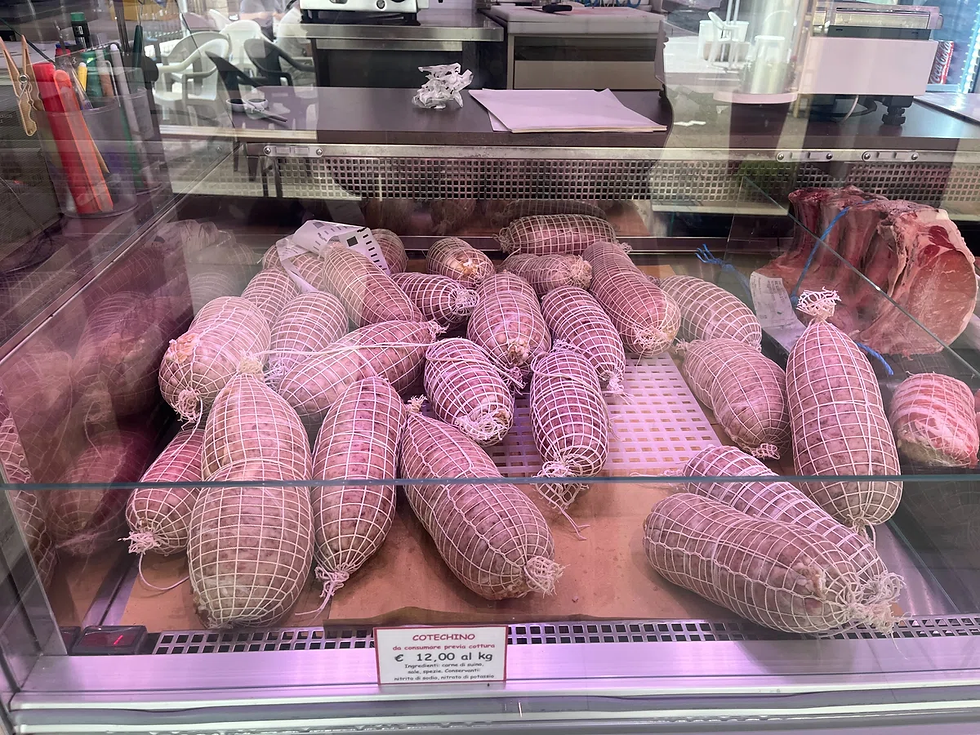

When I actually tried the panino I had bought from a local butcher, the cotechino was incredibly soft. It had an intense richness, almost like eating fat, and perhaps because of the collagen from the pork rind, ‘sticky’ felt like the closest word to describe its texture. It was completely different from dried and cured pork products such as salami. Having been slowly boiled, it was full of moisture, and even the bread it was served in was soft. The only escape was Lambrusco. Haha. But as I kept chewing, the savoury flavour gradually spread through my mouth, and it was absolutely delicious.
Cotechino itself was also born from northern Italy’s pork culture of using as much of the whole pig as possible. The collagen in the pork rind turns gelatinous through long cooking, creating that soft, sticky texture. Seen this way, the very texture that had made me think, ‘Heavy!’, was itself the result of the ingenuity of using not only the meat, but the pork rind as well.
And this was not simply cotechino. Cotechino delle Grazie is recognised under the Municipality of Curtatone’s De.C.O. (Denominazione Comunale di Origine). Unlike EU certifications such as DOP or IGP, De.C.O. is a system through which a municipality recognises products connected to the history and culture of a particular place as part of its local heritage. Interestingly, the cotechino eaten in the middle of summer has also been adapted slightly from the usual winter version. It is made in Curtatone according to a recipe with less salt, spices and fat. In other words, the seemingly strange custom of ‘eating cotechino at Ferragosto’ has now reached the point where even the recipe has been adapted specifically for eating at that time of year, becoming something the local community actively seeks to preserve.
As a little extra, the dessert I had that day was salame dolce di cioccolato con panna—chocolate salami served with whipped cream. It is made by setting chocolate together with crushed biscuits, and when sliced, the cross-section looks just like salami, which is where the name comes from. I had ordered it without knowing what it was, but the moment it arrived, I understood the name. How much salami can there possibly be in one day? Haha. After eating real cotechino, even the chocolate at the end of the meal had taken the form of salami.

The Choice to ‘Do It Again This Year’
In the first part, as I traced the food of Mantova, I came to think that the land shapes ‘what can be eaten’, while people shape ‘how it is eaten’.
But this time, what caught my attention in Grazie was what came after that.
Why do people living hundreds of years later still repeat a way of eating that was created so long ago?
Why do hundreds of people spend the entire night drawing the Virgin Mary on the ground? Why does everyone eat piping-hot cotechino in the morning, at the hottest time of the year? We do not need to do any of these things to survive today. And yet, every year, people gather, draw, pray and eat. They do so even while sometimes complaining: ‘It’s hot,’ ‘That’s heavy on the stomach first thing in the morning,’ or ‘Those figures used to scare me when I was a child.
And including all those memories held in the body, people choose once again: ‘Let’s do it again this year.’
Events that happened in the past have value in themselves as historical facts. But tradition is a little different. The following year, and the year after that, someone has returned to the same place and chosen once again: ‘Let’s do it again this year.’ It is the accumulation of those choices that becomes tradition. Sometimes, as with this cotechino, its form changes slightly to suit the way people live and what they enjoy today, while still preserving what lies at its core.
Perhaps tradition is not so much something that has simply been there since long ago, but something that people living in the present have continued to choose, year after year: ‘Let’s do it again this year.’
I had set out to explore the food culture of the waterside, but before I knew it, I was eating piping-hot pork in a wetland at the height of summer. Yet even this seemingly mismatched scene has become part of the summer landscape of Grazie, precisely because generations of people have chosen to repeat it.
Follow our journey @movimento.metropolitano.


